
Factor C:
Strategic communication with impact
Factor C is often encountered in the field of communication. However, the question remains: what does it really mean in practice? And what does it require of you as a professional? Those who work with Factor C do not opt for a fixed step-by-step plan that you simply tick off. It is not a method that you apply one-to-one. It is a way of looking, thinking and acting. An approach in which you consciously consider the context, the people involved and the purpose of your communication.
This means that Factor C fits well with policy projects and policy programmes that operate according to an environment-oriented or task-oriented process.

What is Factor C?
The core of Factor C revolves around how you view your communication strategy and approach. You don't start from your own message, but from the people who are affected. People who are touched by the subject, for whom something is changing or from whom something is being asked.
Working according to Factor C means that you always put this perspective first.
Not only when writing a core message or creating a communication tool, but throughout the entire process. You constantly ask yourself: what does this mean for them? That is why Factor C is well suited to policy projects and programmes that are environment-oriented or task-oriented. It ties in with an approach that continuously takes the environment and those involved into account.
Factor C in action:
from strategy to implementation
Start with a clear assignment
It is important that you do this from the right perspective. This means that you not only ask yourself which issue or problem you are going to tackle, but that you also consider whether those involved experience this problem or subject in the same way.
Carefully map out the environment
Start your environmental analysis with a clear assignment. Dialog allows you to quickly identify who is involved, what interests are at stake, where the parties stand, how much influence they have, and what the relationships between them are.
Make conscious strategic choices
The environmental analysis forms the basis for your communication strategy. Then you make choices: who do we want to reach, what message is appropriate, and what should the communication achieve? The strategy provides direction and makes it clear when communication is successful.
Develop your plan
With a clear strategy, you can further develop your communication approach. The focus is on the shared narrative: the core message or common thread. At Factor C, this starts with listening. By really hearing what is going on, you can create a message that truly resonates with the target group.
Choose resources that really connect
A strong approach also means choosing the right resources at the right time. You always focus on the people involved: what do they need, when are they open to information, and how can you make it easy for them to ask questions? This ensures that your communication is well aligned with their daily practice.
Evaluate and learn
After completion, it is important to look back before starting a new project. What went well? What could have been better? What are you satisfied with? By evaluating, you learn from your approach and work even harder and more focused on the next project.
‘’Factor C means strategically deploying communication from the outset, with the perspective of the environment as a continuous starting point. It is not a separate part of a project. It is a way of working that focuses on listening, understanding and connecting.’’
Supporting communication tools
for Factor C


So what can you do
with Dialog?
Whether you are working on a project, programme or area-specific task: Dialog supports strategic environment management and helps you to work area-specific with overview, grip and confidence.

Stakeholder database
A complete overview of stakeholders, positions, interests and contact moments. Shareable within your team, secure and structured.

Engagement monitor
Track how stakeholders develop. Signal shifts and make targeted adjustments with up-to-date information.

Stakeholder analysis tool
Bring interests, influence and sensitivities into sharp focus. Indispensable for managing risks and seizing opportunities.
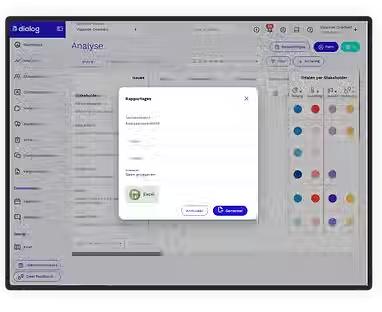
Reports and dashboards
Easily report on involvement, status and bottlenecks. Internally or towards the client or competent authority.
Who is Dialog for?
Dialog is for project leaders, environmental managers, communication advisers and policymakers working on assignments with social impact. Whether you are active in construction, infrastructure, energy or area development: with Dialog, you work on scalable, transparent and future-proof stakeholder management.
Also in long-term or complex collaborations in which strategic and context-oriented working is central.
Want to know more?
Schedule a 20 minute call with Rutger
Curious to find out what Dialog can do for you? Schedule an informal chat and demo with Rutger den Hartog, managing partner of Dialog and expert in strategic stakeholder engagement. He will be happy to think along with you about a smart approach that works in your practice.

See Dialog in action
Learn how Dialog can drive your objectives
Learn more about our pricing
Get help in selecting the right plan for your project
Do you prefer to get in touch with Rutger by mail?
Source: Information based on the article “Factor C – a strategic and structured approach to communication” by Communicatiekompas.
New to Dialog?
Resources
Support
Need help?
Dialog
Bargelaan 200
2333 CW Leiden
The Netherlands

2023 All rights reserved | Privacy statement | Terms and conditions