
This is what a good
stakeholder analysis looks like

Step 1 – What is the challenge?
The Netherlands faces a major societal challenge. Demand for electricity is growing faster than the capacity of the existing electricity grid.
This is creating bottlenecks for:
-
housing construction;
-
economic development;
-
making businesses more sustainable;
-
the energy transition;
-
the electrification of transport.
To enable these developments, the electricity grid must be expanded through:
-
new high-voltage connections;
-
transformer stations;
-
cable routes;
-
energy hubs;
-
smart grid solutions.
Step 2 – What is the aim of community engagement?
The aim of community engagement is not only to achieve the necessary grid expansion, but above all to foster sufficient understanding, trust and cooperation to enable timely decision-making and implementation.
In practical terms, this means:
-
identifying interests at an early stage;
-
reducing public resistance;
-
capitalising on opportunities for cooperation;
-
supporting administrative decision-making;
-
preventing or limiting legal proceedings;
-
reaching widely supported solutions.
Step 3 – Which issues do you identify?
Various societal issues arise from the challenge.
Issue 1: New high-voltage connections
New connections are necessary to increase capacity.
Issue 2: Space required for transformer stations
New stations require scarce space.
Issue 3: Lead times for planning permission procedures
Planning permission and appeal procedures cause delays.
Issue 4: Impact on nature reserves
New infrastructure affects natural heritage.
Issue 5: Capacity shortfall for housing
Housing developments cannot be connected to the grid.
Issue 6: Capacity shortfall for businesses
Businesses cannot expand or become more sustainable.
Issue 7: Changes to the landscape
New energy infrastructure affects the landscape.
Issue 8: Allocation of scarce grid capacity
Not everyone can be connected at the same time.
Step 4 – Which interests are affected?
Issue 1 – New high-voltage connections
Interests:
-
Reliable energy supply
-
Quality of life
-
Health
-
Landscape quality
Why? Society needs a sufficient supply of electricity, whilst local residents wish to maintain their quality of life.
Issue 2 – Transformer stations
Interests:
-
Spatial quality
-
Housing
-
Economic development
Why? The available space must be allocated across various societal functions.
Issue 3 – Planning permission procedures
Interests:
-
Careful decision-making
-
Legal protection
-
Speed of implementation
Why? Public authorities wish to act with due care, whilst the energy transition demands speed.
Issue 4 – Nature reserves
Interests:
-
Biodiversity
-
Climate targets
-
Spatial development
Why? Protecting nature can conflict with the need for new energy infrastructure.
Issue 5 – Housing
Interests:
-
Availability of housing
-
Affordability
-
Economic growth
Why? Without grid capacity, homes cannot be built or connected to the grid.
Issue 6 – Business capacity
Interests:
-
Competitiveness
-
Employment
-
Sustainability
Why? Businesses need electricity to grow and become more sustainable.
Issue 7 – Landscape
Interests:
-
Spatial quality
-
Cultural heritage
-
Recreation
Why? Infrastructure can change the way an area is experienced.
Issue 8 – Capacity allocation
Interests:
-
Equal treatment
-
Economic development
-
Societal priorities
Why? Scarcity requires choices to be made about who gets access to capacity first.
Step 5 – Which stakeholders are involved?
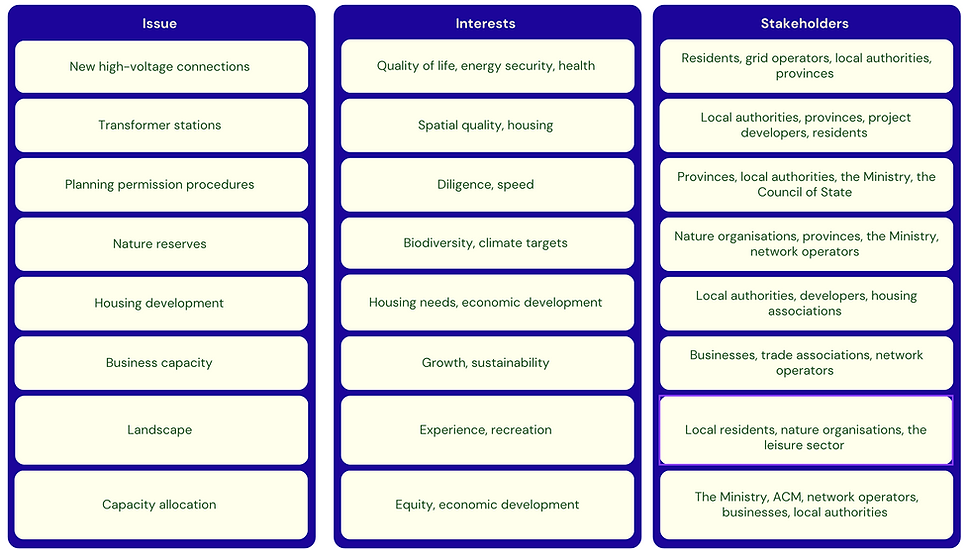
Strategic SOM conclusion
When you look at this analysis, an important insight emerges:
The real issue is not the installation of cables, pylons and substations.
The real issue is how to reconcile interests relating to:
-
energy security;
-
housing;
-
the economy;
-
nature;
-
quality of life;
-
health;
-
with one another.
The task is technical. The challenge is societal. That is precisely why Strategic Environmental Management does not start with stakeholders, but with the task, the issues and the interests affected by them. Only then does it become clear which stakeholders need to be involved in order to arrive at widely supported solutions.
Want to know more?
Schedule a 20 minute call with Rutger
Wondering how a stakeholder engagement can enhance your project? Schedule an informal chat and demo with Rutger den Hartog, managing partner of Dialog and expert in strategic stakeholder engagement. He will be happy to think along with you about a smart approach that works in your practice.

See Dialog in action
Learn how Dialog can drive your objectives
Learn more about our pricing
Get help in selecting the right plan for your project
Do you prefer to get in touch with Rutger by mail?
New to Dialog?
Resources
Support
Need help?
Dialog
Bargelaan 200
2333 CW Leiden
The Netherlands

2023 All rights reserved | Privacy statement | Terms and conditions